Refrigerator Repair
Sub-Zero Losing Temperature Only in the Afternoon
Written by
Yuki Tanabe
Refrigeration technician — controls and sensors · 18 years in the trade
Tests a sensor against an independent reading rather than trusting the display it feeds. Drift is quiet, cheap to correct, and routinely mistaken for a dying compressor.
A built-in that holds 38°F at eight in the morning and reads 46°F by four in the afternoon feels like an intermittent fault, which is the worst kind to describe on the phone. It is not intermittent. It is a machine running out of capacity at the hottest part of the day, and once you know that, the list of possible causes gets short.
This is the most common summer call on the Westside, and the pattern is almost always the same: no error on the display, the freezer column perfectly happy, and a fresh-food side that recovers overnight so that by the time anyone thinks to look again it seems fine.
Why the failure only shows up after lunch
A refrigerator does not make cold. It moves heat from inside the cabinet to the room, and the condenser coil is where that heat gets dumped. How well it can dump it depends on three things: how clean the coil is, how much air the condenser fan is pulling through it, and how hot the air arriving at the coil already is.
In a Los Angeles kitchen in July, the third one changes by fifteen degrees between morning and late afternoon. A coil that can reject enough heat into 74°F air cannot necessarily reject the same amount into 88°F air. So a unit with a partly blocked coil or a tired fan sits comfortably inside its margin all morning and falls off the edge of it in the afternoon.
That is also why the problem reads as sudden. The coil did not block up on the day you noticed; it has been loading for two or three seasons. What changed was the weather.
Kitchens with the cabinet built into a run with no clearance behind, or an undercounter unit boxed into joinery, hit this earlier than a column standing in open cabinetry. Above the canyons it comes earlier again, because the air carries more dust and the coil loads faster.
What is actually happening at the condenser
When the condenser cannot reject heat fast enough, head pressure climbs. The compressor is still running — often it is running constantly, which is the detail most people report first — but each cycle moves less heat than it should. The cabinet loses ground slowly, a degree at a time, all afternoon. Overnight the kitchen cools, the margin comes back, and the unit claws the temperature down again before breakfast.
Three faults produce that curve, and they are worth separating because two of them you can look at yourself:
- A loaded condenser coil. Dust, lint and pet hair matted into the fins. The most common by a distance, and the easiest to see.
- A condenser fan that is turning slowly, or cutting out when hot. Bearings dry out and windings lose efficiency. A fan that spins freely by hand can still be fifteen per cent down under load, which is enough.
- Recirculation. The unit is pulling its own hot discharge air back through the coil because a grille is blocked, a toe-kick panel is missing, or cabinetry has been added since the unit was installed.
None of those are expensive repairs. All of them get worse if you wait, because a compressor running at elevated head pressure all summer is a compressor being aged deliberately.
Four things to check before you call anyone
Switch the unit off at the breaker or the internal switch before you put your hands anywhere near the coil.
- Look at the coil. Pull the lower grille and shine a light at the fins. If you cannot see daylight through them, that is your answer, or a large part of it.
- Watch the fan. With the unit running, the condenser fan should be moving air you can feel at the grille. Silence, or a note that rises and falls, is not normal.
- Take two real readings. A cheap probe thermometer in a glass of water on the middle shelf, read at nine in the morning and again at four. Write both numbers down. That pair of numbers is worth more to the diagnosis than any description.
- Check what is behind and above the unit. Anything stored on top of a built-in, or stacked tight against the side, changes the airflow it was designed around.
What is not worth doing: turning the setpoint colder. A cabinet that cannot hold 38°F will not hold 34°F, and the only thing you change is how long the compressor runs.
When it is a sealed-system problem instead
The afternoon-drift pattern points at heat rejection, but two other faults can imitate it closely enough to matter.
A slow refrigerant loss produces the same shape — adequate in cool conditions, short of capacity when it is hot — and it needs gauges to confirm. The tell is usually that the drift gets worse week on week rather than tracking the weather.
A defrost fault on the fresh-food circuit can also look like it, because a partly iced evaporator loses airflow as the day goes on. Here the giveaway is inside: heavy even frost across the rear interior panel, or a fan noise that changes when you open the door. A cabinet that runs warm and has frost building where it should not is a defrost job, not a condenser job.
Both of those still start with the same measurements, which is why the visit begins with readings rather than with a part.
What the visit looks like
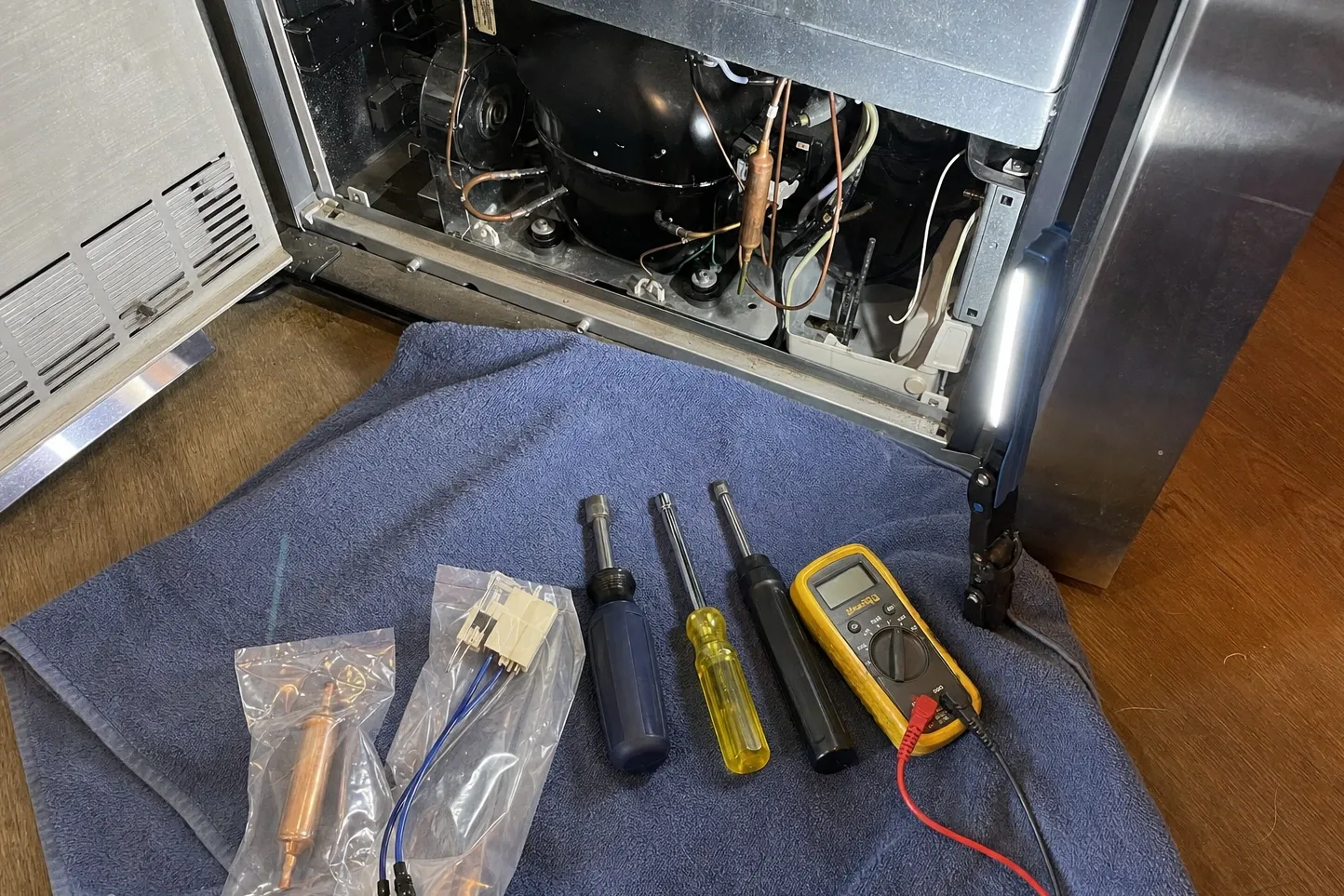
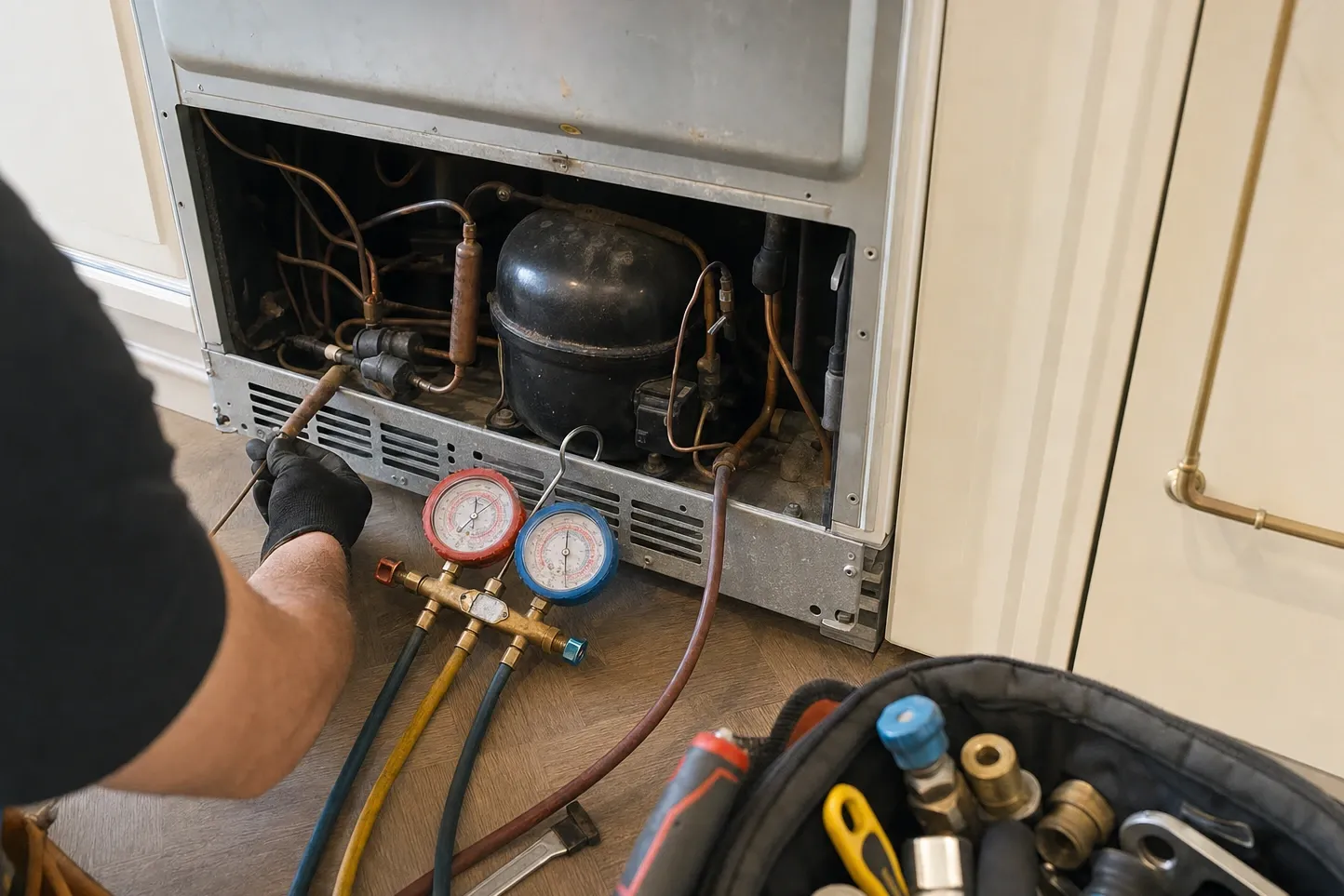
Temperatures at the shelf and at the evaporator, condenser condition and airflow at the grille, current draw at the compressor and the fan, then gauges on the sealed system while it runs — under load, in the afternoon if that is when it fails. The diagnosis usually takes less time than the description did.
If it turns out to be a coil, a fan motor or a blocked airway, you get told that and it is a routine repair. If it is a sealed-system loss, you get told that too, along with an honest view of whether that particular cabinet is worth the work. Most of them are.
Follow-ups
- Is it safe to keep using the fridge while it does this?
- For a day or two, yes, as long as the fresh-food side is staying under 40°F at its worst point in the afternoon. Above that you are in the range where dairy and raw protein should come out. The freezer side is usually unaffected and stays safe to use.
- Will cleaning the condenser myself fix it?
- It can, and the grille is worth clearing whatever else turns out to be wrong: unit off, vacuum, soft brush, no chemicals. What a clean coil cannot correct is a fan turning slower than it should, an iced evaporator behind the rear cover, or a relay that drops out once the bay warms up. Drift returning inside a week means one of those three.
- Why did it start this summer and not last summer?
- Because the margin finally ran out. A coil loads up gradually and a fan motor loses speed gradually, so the cabinet copes for two or three seasons and then meets a hotter week than it can absorb. Nothing broke on the day it started misbehaving.